U bekijkt momenteel de Netherlands versie van de site.
Wilt u overschakelen naar uw lokale site?
<  Laatste editie


Free Sample Issue
Probeer een Gratis monster van Wildlife Australia
Probeer een Gratis monster

Wildlife Australia Magazine Wildlife Australia Magazine Winter 2018 Vorige editie

English
5 Beoordelingen   •  English   •   Leisure Interest (Wildlife)
Only €4,99
Since the start of the Industrial Revolution, the release of greenhouse gases from the burning of fossil fuels – coal, oil and gas – has wrought extraordinary changes on our atmosphere and altered the very nature of the Earth’s climate system, explains Lesley Hughes from the Climate Council. Such rapid change will test many species’ ability to adapt and survive. But what, if anything, are we doing about it?

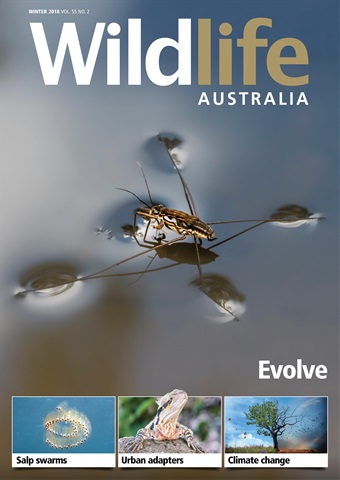
Water striders are considered ‘model’ insects for studying how adapting to ecological conditions can drive speciation. Les Irwig and Tom Weir explore the lifestyles of these unusual invertebrates.

Evolution is everywhere and it’s only getting started. Nature is a seething, swirling whirlpool of chaotic change and its fundamental units aren’t ‘units’ at all but processes – and processes are evolutionary, explains evolutionary biologist Timothy Jackson.

Historically, salps and pyrosomes were considered unimportant components of marine systems. Researchers such as Natasha Henschke are now investigating whether they could increase with climate change and destabilise marine ecosystems.

The greater glider is a highly specialised arboreal marsupial that feeds primarily on eucalyptus leaves and flowers and is sensitive to environmental change and predation. Sadly, we may be the greatest threat posed to its existence, explains Penelope Webster, as we’re responsible for the widespread habitat destruction that threatens its long-term viability.

In general, marsupials are less encephalised than comparable placentals, but among Australian marsupials, bandicoots in the order Peramelemorphia score the lowest for ‘braininess’, out-brained by even the ‘primitive’ monotremes. Why is this so? Antoni Milewski asks.
read more read less
Wildlife Australia Preview Pages Wildlife Australia Preview Pages Wildlife Australia Preview Pages Wildlife Australia Preview Pages Wildlife Australia Preview Pages Wildlife Australia Preview Pages Wildlife Australia Preview Pages

Wildlife Australia

Wildlife Australia Magazine Winter 2018 Since the start of the Industrial Revolution, the release of greenhouse gases from the burning of fossil fuels – coal, oil and gas – has wrought extraordinary changes on our atmosphere and altered the very nature of the Earth’s climate system, explains Lesley Hughes from the Climate Council. Such rapid change will test many species’ ability to adapt and survive. But what, if anything, are we doing about it? Water striders are considered ‘model’ insects for studying how adapting to ecological conditions can drive speciation. Les Irwig and Tom Weir explore the lifestyles of these unusual invertebrates. Evolution is everywhere and it’s only getting started. Nature is a seething, swirling whirlpool of chaotic change and its fundamental units aren’t ‘units’ at all but processes – and processes are evolutionary, explains evolutionary biologist Timothy Jackson. Historically, salps and pyrosomes were considered unimportant components of marine systems. Researchers such as Natasha Henschke are now investigating whether they could increase with climate change and destabilise marine ecosystems. The greater glider is a highly specialised arboreal marsupial that feeds primarily on eucalyptus leaves and flowers and is sensitive to environmental change and predation. Sadly, we may be the greatest threat posed to its existence, explains Penelope Webster, as we’re responsible for the widespread habitat destruction that threatens its long-term viability. In general, marsupials are less encephalised than comparable placentals, but among Australian marsupials, bandicoots in the order Peramelemorphia score the lowest for ‘braininess’, out-brained by even the ‘primitive’ monotremes. Why is this so? Antoni Milewski asks.


FORMAAT SELECTEREN:
Directe toegang

Beschikbare digitale aanbiedingen:

Enkele digitale uitgave Wildlife Australia Magazine Winter 2018
 
€4,99 / issue
Deze editie en andere oude edities zijn niet opgenomen in een Wildlife Australia abonnement. Abonnementen omvatten de nieuwste reguliere editie en nieuwe uitgaven die tijdens uw abonnement zijn uitgebracht en beginnen vanaf slechts €3,75 per uitgave . Als je je wilt abonneren, kijk dan op onze Abonnementsopties
Besparingen zijn berekend op de vergelijkbare aankoop van losse nummers over een abonnementsperiode op jaarbasis en kunnen afwijken van geadverteerde bedragen. Berekeningen dienen alleen ter illustratie. Digitale abonnementen omvatten het laatste nummer en alle reguliere nummers die tijdens uw abonnement verschijnen, tenzij anders vermeld. De door u gekozen termijn wordt automatisch verlengd, tenzij u tot 24 uur voor het einde van het lopende abonnement opzegt in de Mijn Account-zone.

Wildlife Australia issue Wildlife Australia Magazine Winter 2018

Wildlife Australia  |  Wildlife Australia Magazine Winter 2018  


Since the start of the Industrial Revolution, the release of greenhouse gases from the burning of fossil fuels – coal, oil and gas – has wrought extraordinary changes on our atmosphere and altered the very nature of the Earth’s climate system, explains Lesley Hughes from the Climate Council. Such rapid change will test many species’ ability to adapt and survive. But what, if anything, are we doing about it?

Water striders are considered ‘model’ insects for studying how adapting to ecological conditions can drive speciation. Les Irwig and Tom Weir explore the lifestyles of these unusual invertebrates.

Evolution is everywhere and it’s only getting started. Nature is a seething, swirling whirlpool of chaotic change and its fundamental units aren’t ‘units’ at all but processes – and processes are evolutionary, explains evolutionary biologist Timothy Jackson.

Historically, salps and pyrosomes were considered unimportant components of marine systems. Researchers such as Natasha Henschke are now investigating whether they could increase with climate change and destabilise marine ecosystems.

The greater glider is a highly specialised arboreal marsupial that feeds primarily on eucalyptus leaves and flowers and is sensitive to environmental change and predation. Sadly, we may be the greatest threat posed to its existence, explains Penelope Webster, as we’re responsible for the widespread habitat destruction that threatens its long-term viability.

In general, marsupials are less encephalised than comparable placentals, but among Australian marsupials, bandicoots in the order Peramelemorphia score the lowest for ‘braininess’, out-brained by even the ‘primitive’ monotremes. Why is this so? Antoni Milewski asks.
meer lezen minder lezen
Embrace a wilder life – download Wildlife Australia, the country’s leading nature magazine. Fifty pages of insightful and thought-provoking articles and stunning photographs.
Celebration: Celebrate the essence of Australia – its vast wild landscapes and distinctive wildlife, most found nowhere else in the world
Insights: The articles are written by leading researchers and those whose care for nature comes from deep insights. You won’t find this information by Googling.
Beauty: Immerse yourself in the allure and charm of wildlife with photos by some of Australia’s leading nature photographers.
Understanding: Wildlife Australia is a hub for people who value their relationship with nature and know it is enriched by knowledge. The nature experience can be powerful, but often requires interpretation.
Inspiration: Be inspired by what people are doing to understand and protect nature.
Conservation: Wildlife Australia is a not-for-profit magazine and all profits go to protect nature.

A subscription to Wildlife Australia won't cure arthritis or tonsillitis, but is great for two modern ailments: dislocation from nature and existential malaise. Download the app and see.

Als abonnee ontvang je de volgende voordelen:


•  Een korting op de verkoopprijs van je tijdschrift
•  Je tijdschrift elke maand op je apparaat
•  Je zult nooit een editie missen
•  Je bent beschermd tegen prijsstijgingen die later in het jaar kunnen plaatsvinden

Je ontvangt 4 edities gedurende een periode van 1 jaar Wildlife Australia abonnement op een tijdschrift.

Opmerking: Digitale edities bevatten niet de omslagitems of supplementen die je zou vinden bij gedrukte exemplaren.

Uw aankoop hier op Pocketmags.com kan op elk van de volgende platforms worden gelezen.


Je kunt hier lezen op de website of de app downloaden voor jouw platform, vergeet niet in te loggen met je Pocketmags gebruikersnaam en wachtwoord.

Apple Pocketmags Online Pocketmags Google Pocketmags
De Pocketmags-app werkt op alle iPad- en iPhone-apparaten met iOS 15.6 of hoger, Android 8.0 o hoger, en Amazon Fire-tablets vanaf 2018, hoewel eigenaren van oudere Fire-modellen de Amazon Appstore rechtstreeks op hun apparaat kunnen controleren om de compatibiliteit te bevestigen. Voor iOS-gebruikers raden we aan een apparaat te gebruiken dat de nieuwste versie van iOS kan draaien voor optimale prestaties en stabiliteit, aangezien oudere hardware met minder processorkracht en RAM-geheugen een tragere paginaweergave of incidentele stabiliteitsproblemen kan ervaren als gevolg van geheugenbeperkingen van het apparaat. Als alternatief werkt onze web-reader met elke moderne, HTML5-compatibele browser, hoewel we Chrome of Firefox aanbevelen voor de beste ervaring op pc en Mac.
5,0
/5
Gebaseerd op 5 Beoordelingen van klanten
5
5
4
0
3
0
2
0
1
0
Bekijk beoordelingen

Artikelen in deze editie


Hieronder vindt u een selectie van artikelen in Wildlife Australia Wildlife Australia Magazine Winter 2018.

Free Sample Issue
Probeer een Gratis monster van Wildlife Australia
Chat
X
Pocketmags ondersteuning