Está atualmente a visualizar o Portugal versão do sítio.
Gostaria de mudar para o seu sítio local?
Última edição


Free Sample Issue
Experimente uma amostra GRATUITA de Wildlife Australia
Experimente uma amostra GRATUITA

Wildlife Australia Magazine Wildlife Australia Magazine Winter 2018 Edição anterior

English
5 Comentários   •  English   •   Leisure Interest (Wildlife)
Only €4,99
Since the start of the Industrial Revolution, the release of greenhouse gases from the burning of fossil fuels – coal, oil and gas – has wrought extraordinary changes on our atmosphere and altered the very nature of the Earth’s climate system, explains Lesley Hughes from the Climate Council. Such rapid change will test many species’ ability to adapt and survive. But what, if anything, are we doing about it?

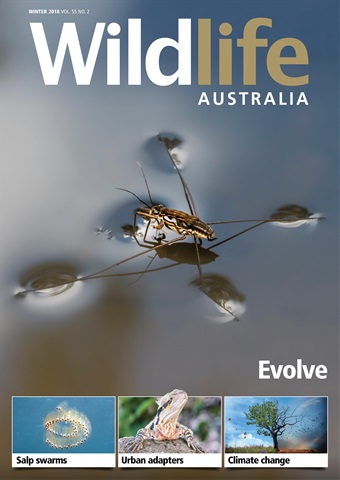
Water striders are considered ‘model’ insects for studying how adapting to ecological conditions can drive speciation. Les Irwig and Tom Weir explore the lifestyles of these unusual invertebrates.

Evolution is everywhere and it’s only getting started. Nature is a seething, swirling whirlpool of chaotic change and its fundamental units aren’t ‘units’ at all but processes – and processes are evolutionary, explains evolutionary biologist Timothy Jackson.

Historically, salps and pyrosomes were considered unimportant components of marine systems. Researchers such as Natasha Henschke are now investigating whether they could increase with climate change and destabilise marine ecosystems.

The greater glider is a highly specialised arboreal marsupial that feeds primarily on eucalyptus leaves and flowers and is sensitive to environmental change and predation. Sadly, we may be the greatest threat posed to its existence, explains Penelope Webster, as we’re responsible for the widespread habitat destruction that threatens its long-term viability.

In general, marsupials are less encephalised than comparable placentals, but among Australian marsupials, bandicoots in the order Peramelemorphia score the lowest for ‘braininess’, out-brained by even the ‘primitive’ monotremes. Why is this so? Antoni Milewski asks.
read more read less
Wildlife Australia Preview Pages Wildlife Australia Preview Pages Wildlife Australia Preview Pages Wildlife Australia Preview Pages Wildlife Australia Preview Pages Wildlife Australia Preview Pages Wildlife Australia Preview Pages

Wildlife Australia

Wildlife Australia Magazine Winter 2018 Since the start of the Industrial Revolution, the release of greenhouse gases from the burning of fossil fuels – coal, oil and gas – has wrought extraordinary changes on our atmosphere and altered the very nature of the Earth’s climate system, explains Lesley Hughes from the Climate Council. Such rapid change will test many species’ ability to adapt and survive. But what, if anything, are we doing about it? Water striders are considered ‘model’ insects for studying how adapting to ecological conditions can drive speciation. Les Irwig and Tom Weir explore the lifestyles of these unusual invertebrates. Evolution is everywhere and it’s only getting started. Nature is a seething, swirling whirlpool of chaotic change and its fundamental units aren’t ‘units’ at all but processes – and processes are evolutionary, explains evolutionary biologist Timothy Jackson. Historically, salps and pyrosomes were considered unimportant components of marine systems. Researchers such as Natasha Henschke are now investigating whether they could increase with climate change and destabilise marine ecosystems. The greater glider is a highly specialised arboreal marsupial that feeds primarily on eucalyptus leaves and flowers and is sensitive to environmental change and predation. Sadly, we may be the greatest threat posed to its existence, explains Penelope Webster, as we’re responsible for the widespread habitat destruction that threatens its long-term viability. In general, marsupials are less encephalised than comparable placentals, but among Australian marsupials, bandicoots in the order Peramelemorphia score the lowest for ‘braininess’, out-brained by even the ‘primitive’ monotremes. Why is this so? Antoni Milewski asks.


SELECCIONAR FORMATO:
Acesso imediato

Ofertas digitais disponíveis:

Edição digital única Wildlife Australia Magazine Winter 2018
 
4,99 / issue
Esta edição e outras edições anteriores não estão incluídas numa Wildlife Australia inscrição. As assinaturas incluem a edição regular mais recente e os novos números lançados durante sua assinatura e começam a partir de €3,75 por edição . Se pretende subscrever, consulte o nosso Opções de assinatura
As poupanças são calculadas com base na compra comparável de edições únicas durante um período de subscrição anual e podem variar em relação aos montantes anunciados. Os cálculos destinam-se apenas a fins ilustrativos. As assinaturas digitais incluem a última edição e todas as edições regulares lançadas durante a sua assinatura, salvo indicação em contrário. O período escolhido será renovado automaticamente, exceto se for cancelado na área A minha conta até 24 horas antes do fim da assinatura atual.

Wildlife Australia issue Wildlife Australia Magazine Winter 2018

Wildlife Australia  |  Wildlife Australia Magazine Winter 2018  


Since the start of the Industrial Revolution, the release of greenhouse gases from the burning of fossil fuels – coal, oil and gas – has wrought extraordinary changes on our atmosphere and altered the very nature of the Earth’s climate system, explains Lesley Hughes from the Climate Council. Such rapid change will test many species’ ability to adapt and survive. But what, if anything, are we doing about it?

Water striders are considered ‘model’ insects for studying how adapting to ecological conditions can drive speciation. Les Irwig and Tom Weir explore the lifestyles of these unusual invertebrates.

Evolution is everywhere and it’s only getting started. Nature is a seething, swirling whirlpool of chaotic change and its fundamental units aren’t ‘units’ at all but processes – and processes are evolutionary, explains evolutionary biologist Timothy Jackson.

Historically, salps and pyrosomes were considered unimportant components of marine systems. Researchers such as Natasha Henschke are now investigating whether they could increase with climate change and destabilise marine ecosystems.

The greater glider is a highly specialised arboreal marsupial that feeds primarily on eucalyptus leaves and flowers and is sensitive to environmental change and predation. Sadly, we may be the greatest threat posed to its existence, explains Penelope Webster, as we’re responsible for the widespread habitat destruction that threatens its long-term viability.

In general, marsupials are less encephalised than comparable placentals, but among Australian marsupials, bandicoots in the order Peramelemorphia score the lowest for ‘braininess’, out-brained by even the ‘primitive’ monotremes. Why is this so? Antoni Milewski asks.
ler mais ler menos
Embrace a wilder life – download Wildlife Australia, the country’s leading nature magazine. Fifty pages of insightful and thought-provoking articles and stunning photographs.
Celebration: Celebrate the essence of Australia – its vast wild landscapes and distinctive wildlife, most found nowhere else in the world
Insights: The articles are written by leading researchers and those whose care for nature comes from deep insights. You won’t find this information by Googling.
Beauty: Immerse yourself in the allure and charm of wildlife with photos by some of Australia’s leading nature photographers.
Understanding: Wildlife Australia is a hub for people who value their relationship with nature and know it is enriched by knowledge. The nature experience can be powerful, but often requires interpretation.
Inspiration: Be inspired by what people are doing to understand and protect nature.
Conservation: Wildlife Australia is a not-for-profit magazine and all profits go to protect nature.

A subscription to Wildlife Australia won't cure arthritis or tonsillitis, but is great for two modern ailments: dislocation from nature and existential malaise. Download the app and see.

Como subscritor, receberá as seguintes vantagens


•  Um desconto no PVP da sua revista
•  Novas edições entregues no seu dispositivo no dia do lançamento
•  Nunca perderá uma edição
•  Está protegido contra aumentos de preços que possam ocorrer no final do ano

Receberá 4 edições durante um ano Wildlife Australia assinatura da revista.

Nota: As edições digitais não incluem os artigos de capa ou os suplementos que se encontram nos exemplares impressos.

Sua compra aqui no Pocketmags.com pode ser lida em qualquer uma das seguintes plataformas.


Pode ler aqui no sítio Web ou descarregar a aplicação para a sua plataforma, mas não se esqueça de iniciar sessão com o seu nome de utilizador e palavra-passe Pocketmags.

Apple Pocketmags Online Pocketmags Google Pocketmags
O aplicativo Pocketmags funciona em todos os dispositivos iPad e iPhone com iOS 15.6 ou superior, Android 8.0 ou superior e tablets Amazon Fire de 2018 em diante, embora os proprietários de modelos Fire anteriores possam verificar a Amazon Appstore diretamente em seus dispositivos para confirmar a compatibilidade. Para usuários de iOS, recomendamos o uso de um dispositivo capaz de executar a versão mais recente do iOS para obter melhor desempenho e estabilidade, pois hardwares mais antigos com menor capacidade de processamento e memória RAM podem apresentar renderização de páginas mais lenta ou problemas ocasionais de estabilidade devido a limitações de memória do dispositivo. Como alternativa, nosso leitor web funciona com qualquer navegador moderno compatível com HTML5, embora recomendemos o Chrome ou o Firefox para a melhor experiência no PC e Mac.
5,0
/5
Com base em 5 Comentários de clientes
5
5
4
0
3
0
2
0
1
0
Ver críticas

Artigos desta edição


Segue-se uma seleção de artigos em Wildlife Australia Wildlife Australia Magazine Winter 2018.

Free Sample Issue
Experimente uma amostra GRATUITA de Wildlife Australia
Conversa
X
Suporte Pocketmags