Está viendo la página Spain versión del sitio.
Le gustaría cambiar a su sitio local?
Última edición


Free Sample Issue
Pruebe una muestra GRATIS de Wildlife Australia
Pruebe una muestra GRATIS de

Wildlife Australia Magazine Spring 2024 Edición anterior

English
5 Reseñas   •  English   •   Leisure Interest (Wildlife)
Only €4,99
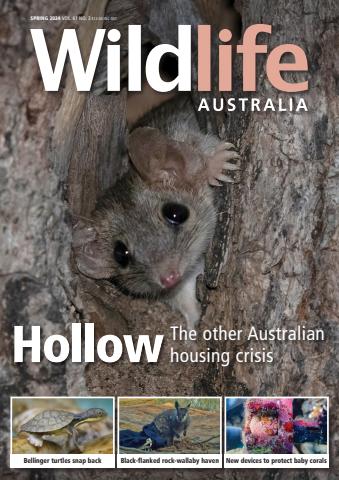
Hallowed mission to protect hollows

AUSTRALIAN wildlife is unique in its dependency on tree hollows – even dead and fallen tree hollows.

This edition looks at the need to protect old-growth bushland, with its abundance of hollows, versus the ease with which that thriving forest can be flattened.

Some ecosystems are at inflection points that could result in local disappearances of koalas, antechinus, possums and – most telling of all – our unique gliders, largely because of bush clearing and the wholesale loss of hollows.

Wildlife Information, Rescue and Education Service (WIRES) speaks plainly about the role hollows play in Australia’s bush ecosystem health.

“Small hollows with narrow entrances suitable for small animals such as the brush-tailed phascogale and the eastern pygmy-possum take about 100 years to form,” WIRES reports. “Hollows of a medium size and suitable for animals such as parrots will take around 200 years to form.

“In Australia many native species need tree hollows, including 17% of bird species, 42% of mammals and 28% of reptiles. They include bats, possums, gliders, owls, parrots, antechinus, ducks, rosellas and kingfishers as well as numerous species of snakes, frogs and skinks.”
This puts the recent dialogue Wildlife Queensland leaders had with Queensland Government environment officials into perspective, leading up to government assurances to secure vital greater glider forest habitat.

A few weeks after this meeting, a Wildlife Queensland team of experts and citizen scientists ventured into St Mary State Forest, near Maryborough, to document a population of greater gliders (Petauroides volans) – but were shocked to see logging taking place less than 3km from this site.

This edition features a range of stories that state and re-state the importance of protecting bushland in which hollows are a feature. Hollows could rightfully be named as one of Australia’s greatest natural resources.
read more read less
Wildlife Australia Preview Pages Wildlife Australia Preview Pages Wildlife Australia Preview Pages Wildlife Australia Preview Pages Wildlife Australia Preview Pages Wildlife Australia Preview Pages Wildlife Australia Preview Pages Wildlife Australia Preview Pages

Wildlife Australia

Spring 2024 Hallowed mission to protect hollows AUSTRALIAN wildlife is unique in its dependency on tree hollows – even dead and fallen tree hollows. This edition looks at the need to protect old-growth bushland, with its abundance of hollows, versus the ease with which that thriving forest can be flattened. Some ecosystems are at inflection points that could result in local disappearances of koalas, antechinus, possums and – most telling of all – our unique gliders, largely because of bush clearing and the wholesale loss of hollows. Wildlife Information, Rescue and Education Service (WIRES) speaks plainly about the role hollows play in Australia’s bush ecosystem health. “Small hollows with narrow entrances suitable for small animals such as the brush-tailed phascogale and the eastern pygmy-possum take about 100 years to form,” WIRES reports. “Hollows of a medium size and suitable for animals such as parrots will take around 200 years to form. “In Australia many native species need tree hollows, including 17% of bird species, 42% of mammals and 28% of reptiles. They include bats, possums, gliders, owls, parrots, antechinus, ducks, rosellas and kingfishers as well as numerous species of snakes, frogs and skinks.” This puts the recent dialogue Wildlife Queensland leaders had with Queensland Government environment officials into perspective, leading up to government assurances to secure vital greater glider forest habitat. A few weeks after this meeting, a Wildlife Queensland team of experts and citizen scientists ventured into St Mary State Forest, near Maryborough, to document a population of greater gliders (Petauroides volans) – but were shocked to see logging taking place less than 3km from this site. This edition features a range of stories that state and re-state the importance of protecting bushland in which hollows are a feature. Hollows could rightfully be named as one of Australia’s greatest natural resources.


SELECCIONAR FORMATO:
Acceso instantáneo

Ofertas digitales disponibles:

Ejemplar digital único Spring 2024
 
4,99 / issue
Este número y otros números atrasados no se incluyen en un Wildlife Australia suscripción. Las suscripciones incluyen el último número de la revista y los nuevos números publicados durante el periodo de suscripción. €3,75 por número . Si desea suscribirse, consulte nuestro Opciones de suscripción
Los ahorros se calculan sobre la compra comparable de números sueltos durante un periodo de suscripción anualizado y pueden variar respecto a los importes anunciados. Los cálculos son meramente ilustrativos. Las suscripciones digitales incluyen el último número y todos los números regulares publicados durante su suscripción, a menos que se indique lo contrario. El periodo elegido se renovará automáticamente a menos que se cancele en el área Mi cuenta hasta 24 horas antes del final de la suscripción actual.

Wildlife Australia issue Spring 2024

Wildlife Australia  |  Spring 2024  


Hallowed mission to protect hollows

AUSTRALIAN wildlife is unique in its dependency on tree hollows – even dead and fallen tree hollows.

This edition looks at the need to protect old-growth bushland, with its abundance of hollows, versus the ease with which that thriving forest can be flattened.

Some ecosystems are at inflection points that could result in local disappearances of koalas, antechinus, possums and – most telling of all – our unique gliders, largely because of bush clearing and the wholesale loss of hollows.

Wildlife Information, Rescue and Education Service (WIRES) speaks plainly about the role hollows play in Australia’s bush ecosystem health.

“Small hollows with narrow entrances suitable for small animals such as the brush-tailed phascogale and the eastern pygmy-possum take about 100 years to form,” WIRES reports. “Hollows of a medium size and suitable for animals such as parrots will take around 200 years to form.

“In Australia many native species need tree hollows, including 17% of bird species, 42% of mammals and 28% of reptiles. They include bats, possums, gliders, owls, parrots, antechinus, ducks, rosellas and kingfishers as well as numerous species of snakes, frogs and skinks.”
This puts the recent dialogue Wildlife Queensland leaders had with Queensland Government environment officials into perspective, leading up to government assurances to secure vital greater glider forest habitat.

A few weeks after this meeting, a Wildlife Queensland team of experts and citizen scientists ventured into St Mary State Forest, near Maryborough, to document a population of greater gliders (Petauroides volans) – but were shocked to see logging taking place less than 3km from this site.

This edition features a range of stories that state and re-state the importance of protecting bushland in which hollows are a feature. Hollows could rightfully be named as one of Australia’s greatest natural resources.
Seguir leyendo leer menos
Embrace a wilder life – download Wildlife Australia, the country’s leading nature magazine. Fifty pages of insightful and thought-provoking articles and stunning photographs.
Celebration: Celebrate the essence of Australia – its vast wild landscapes and distinctive wildlife, most found nowhere else in the world
Insights: The articles are written by leading researchers and those whose care for nature comes from deep insights. You won’t find this information by Googling.
Beauty: Immerse yourself in the allure and charm of wildlife with photos by some of Australia’s leading nature photographers.
Understanding: Wildlife Australia is a hub for people who value their relationship with nature and know it is enriched by knowledge. The nature experience can be powerful, but often requires interpretation.
Inspiration: Be inspired by what people are doing to understand and protect nature.
Conservation: Wildlife Australia is a not-for-profit magazine and all profits go to protect nature.

A subscription to Wildlife Australia won't cure arthritis or tonsillitis, but is great for two modern ailments: dislocation from nature and existential malaise. Download the app and see.

omo abonado recibirá las siguientes ventajas:


•  Un descuento sobre el PVP de su revista
•  Las nuevas ediciones se envían a tu dispositivo el día de su lanzamiento
•  Nunca te perderás un número
•  Estás protegido de las subidas de precios que puedan producirse más adelante en el año

Recibirás 4 problemas durante un año Wildlife Australia suscripción a la revista.

Nota: Las ediciones digitales no incluyen los artículos de portada ni los suplementos que encontraría en los ejemplares impresos.

Su compra aquí en Pocketmags.com puede leerse en cualquiera de las siguientes plataformas.


Puedes leer aquí en el sitio web o descargar la aplicación para tu plataforma, sólo recuerda iniciar sesión con tu nombre de usuario y contraseña de Pocketmags.

Apple Pocketmags Online Pocketmags Google Pocketmags
La aplicación Pocketmags funciona en todos los dispositivos iPad y iPhone con iOS 15.6 o superior, Android 8.0 o superior y tabletas Amazon Fire de 2018 en adelante, aunque los propietarios de modelos Fire anteriores pueden consultar la Amazon Appstore directamente en su dispositivo para confirmar la compatibilidad. Para los usuarios de iOS, recomendamos utilizar un dispositivo capaz de ejecutar la última versión de iOS para un rendimiento y estabilidad óptimos, ya que el hardware más antiguo con menor potencia de procesamiento y memoria RAM puede experimentar una renderización de páginas más lenta o problemas ocasionales de estabilidad debido a las limitaciones de memoria del dispositivo. Alternativamente, nuestro lector web funciona con cualquier navegador moderno compatible con HTML5, aunque recomendamos Chrome o Firefox para disfrutar de la mejor experiencia en PC y Mac.
5,0
/5
Basado en 5 Opiniones de los clientes
5
5
4
0
3
0
2
0
1
0
Ver comentarios

Artículos de este número


A continuación encontrará una selección de artículos en Wildlife Australia Spring 2024.

Free Sample Issue
Pruebe una muestra GRATIS de Wildlife Australia
Chat
X
Soporte Pocketmags