Vous consultez actuellement le France version du site.
Voulez-vous passer à votre site local ?
<  Dernière édition

Aviation Specials Magazine Sulzer Power Édition spéciale

English
47 Critiques   •  English   •   Aviation & Transport (Aviation)
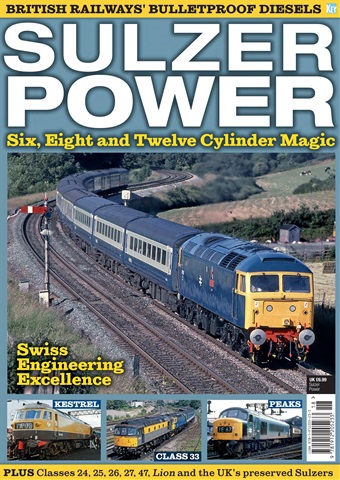
Welcome to this special publication dedicated to the Sulzer-powered locomotives that served Britain’s railways from the late 1950s. The Swiss engineering company Sulzer had a long history developing diesel engines and was an early exponent of marrying the technology to rail transport. Its work before World War Two stood it in good stead after the conflict ended in 1945 and it was soon supplying diesel engines of varying sizes to railways in Europe and around the world.

With the publishing of British Railways’ 1955 Modernisation Plan another huge opportunity arose and Sulzer found itself providing hundreds of power units for Type 2, 3 and 4 locos well into the 1960s. Its engines were only matched in number by its main rival in the UK market, English Electric. A notable difference between the two was the engine configuration, with EE favouring the V layout while Sulzer preferred an in-line cylinder arrangement. To produce more powerful engines developing more than 2,000hp for Type 4 locos, Sulzer chose to put two in-line six units side by side to create a 12-cylinder unit that drove a single output shaft to turn the generator. This did produce a heavy power unit, and made some components difficult to access for maintenance, but the low-revving four strokes were very reliable, particularly those fitted to the British Railways’ Peaks and in the Class 47, once they were de-rated.

Today the only Sulzer-powered locos still regularly active on the main line are some Class 47s, although a handful of Class 25s and 33s can be seen on the network, while plenty more, including 26s and 27s, can be found active in preservation. That is quite remarkable given most are approaching 60 years old and is testament to the engineering and near bulletproof design of the Sulzer diesels.

Mark Nicholls, Editor, Railways Illustrated
read more read less
Aviation Specials Preview Pages Aviation Specials Preview Pages Aviation Specials Preview Pages Aviation Specials Preview Pages Aviation Specials Preview Pages Aviation Specials Preview Pages

Aviation Specials

Sulzer Power Welcome to this special publication dedicated to the Sulzer-powered locomotives that served Britain’s railways from the late 1950s. The Swiss engineering company Sulzer had a long history developing diesel engines and was an early exponent of marrying the technology to rail transport. Its work before World War Two stood it in good stead after the conflict ended in 1945 and it was soon supplying diesel engines of varying sizes to railways in Europe and around the world. With the publishing of British Railways’ 1955 Modernisation Plan another huge opportunity arose and Sulzer found itself providing hundreds of power units for Type 2, 3 and 4 locos well into the 1960s. Its engines were only matched in number by its main rival in the UK market, English Electric. A notable difference between the two was the engine configuration, with EE favouring the V layout while Sulzer preferred an in-line cylinder arrangement. To produce more powerful engines developing more than 2,000hp for Type 4 locos, Sulzer chose to put two in-line six units side by side to create a 12-cylinder unit that drove a single output shaft to turn the generator. This did produce a heavy power unit, and made some components difficult to access for maintenance, but the low-revving four strokes were very reliable, particularly those fitted to the British Railways’ Peaks and in the Class 47, once they were de-rated. Today the only Sulzer-powered locos still regularly active on the main line are some Class 47s, although a handful of Class 25s and 33s can be seen on the network, while plenty more, including 26s and 27s, can be found active in preservation. That is quite remarkable given most are approaching 60 years old and is testament to the engineering and near bulletproof design of the Sulzer diesels. Mark Nicholls, Editor, Railways Illustrated


SELECTIONNER LE FORMAT :
Accès instantané

Offres numériques disponibles :

Numéro spécial numérique Sulzer Power
 
€7,99 / issue
Ce numéro spécial n'est pas inclus dans un Aviation Specials abonnement. Les abonnements comprennent le dernier numéro régulier et les nouveaux numéros publiés pendant la durée de l'abonnement.

Options d'abonnement
Les économies sont calculées sur la base d'un achat comparable de numéros uniques sur une période d'abonnement annualisée et peuvent varier par rapport aux montants annoncés. Les calculs sont effectués à des fins d'illustration uniquement. Les abonnements numériques comprennent le dernier numéro et tous les numéros réguliers publiés au cours de l'abonnement, sauf indication contraire. L'abonnement choisi sera automatiquement renouvelé s'il n'est pas résilié dans la section Mon compte jusqu'à 24 heures avant la fin de l'abonnement en cours.

Aviation Specials issue Sulzer Power

Aviation Specials  |  Sulzer Power  


Welcome to this special publication dedicated to the Sulzer-powered locomotives that served Britain’s railways from the late 1950s. The Swiss engineering company Sulzer had a long history developing diesel engines and was an early exponent of marrying the technology to rail transport. Its work before World War Two stood it in good stead after the conflict ended in 1945 and it was soon supplying diesel engines of varying sizes to railways in Europe and around the world.

With the publishing of British Railways’ 1955 Modernisation Plan another huge opportunity arose and Sulzer found itself providing hundreds of power units for Type 2, 3 and 4 locos well into the 1960s. Its engines were only matched in number by its main rival in the UK market, English Electric. A notable difference between the two was the engine configuration, with EE favouring the V layout while Sulzer preferred an in-line cylinder arrangement. To produce more powerful engines developing more than 2,000hp for Type 4 locos, Sulzer chose to put two in-line six units side by side to create a 12-cylinder unit that drove a single output shaft to turn the generator. This did produce a heavy power unit, and made some components difficult to access for maintenance, but the low-revving four strokes were very reliable, particularly those fitted to the British Railways’ Peaks and in the Class 47, once they were de-rated.

Today the only Sulzer-powered locos still regularly active on the main line are some Class 47s, although a handful of Class 25s and 33s can be seen on the network, while plenty more, including 26s and 27s, can be found active in preservation. That is quite remarkable given most are approaching 60 years old and is testament to the engineering and near bulletproof design of the Sulzer diesels.

Mark Nicholls, Editor, Railways Illustrated
en savoir plus lire moins
Key’s Aviation Special Magazines – Essential reading from the teams behind your favourite aviation magazines!

Brought to you by Key Publishing Ltd, Europe’s Leading Aviation Publisher, you can purchase and read all the latest Book-a-zines and Aviation Specials in one handy app. Purchase issues here at Pocketmags or via the App for Apple and Android - click the Available On links to download.

Subjects covered include:

• Historic military aviation - special magazines celebrating iconic aircraft such as the Spitfire, Hurricane, Mosquito, Vulcan bomber and the acclaimed RAF Salute series and specials on the Battle of Britain and the RAF 90th anniversary.

• Historic commercial aviation - download and read the entire best-selling Airliner Classics series written by the Airliner World editorial team.

• Modern military aviation and aerospace – read aviation specials covering air forces and services from around the world. Titles include official RAF yearbooks, UK and US Navy Airpower specials, Air Combat and aerospace chronologies including 100 years of British Flight, Great Fighters of the World and our Space special celebrating 50 years of human space flight.

• Flight Simulation – read the essential guides to maximising your enjoyment of your hobby, includes the Beginners Guide and Airliners special issues.

“HORNBY” and ‘’AIRFIX’’ are registered trade marks of Hornby Hobbies Limited and are used under licence.

Please note: The Flight Simulation Special digital versions do not include access to the CD ROM files received with the print editions.

Published by Key Publishing Ltd. The entire contents of this title is © copyright 2015. All rights reserved.

En tant qu'abonné, vous bénéficierez des avantages suivants :


•  Une réduction sur le prix de vente conseillé de votre magazine
•  Les nouvelles éditions sont livrées sur votre appareil le jour même de leur sortie
•  Vous ne manquerez jamais un numéro
•  Vous êtes protégé contre les hausses de prix qui pourraient survenir plus tard dans l'année.

Vous recevrez 12 pendant une période de 1 an Aviation Specials abonnement au magazine.

Remarque : les éditions numériques ne comprennent pas les éléments de couverture ou les suppléments que vous trouveriez avec les copies imprimées.

Votre achat ici à Pocketmags.com peut être lu sur l'une des plateformes suivantes.


Vous pouvez le lire ici sur le site web ou télécharger l'application pour votre plateforme, n'oubliez pas de vous connecter avec votre nom d'utilisateur et votre mot de passe Pocketmags.

Apple Pocketmags Online Pocketmags Google Pocketmags
L'application Pocketmags fonctionne sur tous les appareils iPad et iPhone équipés d'iOS 15.6 ou version ultérieure, Android 8.0 ou version ultérieure, et sur les tablettes Amazon Fire à partir de 2018. Les propriétaires de modèles Fire plus anciens peuvent toutefois vérifier la compatibilité directement sur l'Amazon Appstore de leur appareil. Pour les utilisateurs d'iOS, nous recommandons d'utiliser un appareil capable de s'exécuter sous la dernière version d'iOS afin de garantir des performances et une stabilité optimales. En effet, les anciens équipements dotés d'une puissance de traitement et d'une mémoire RAM inférieures peuvent présenter des ralentissements lors du chargement des pages ou des problèmes de stabilité occasionnels dus aux limites de mémoire de l'appareil. Alternativement, notre lecteur web fonctionne avec n'importe quel navigateur moderne compatible HTML5, bien que nous recommandions Chrome ou Firefox pour une expérience optimale sur PC et Mac.
4,5
/5
Sur la base de 47 Commentaires des clients
5
29
4
15
3
1
2
2
1
0
Voir les commentaires

Aviation Specials

Quality is top Révision 15 juillet 2026

Aviation Specials

great magazine Révision 27 novembre 2020

Aviation Specials

very detailed and comprehensive
a collection encompasing all the specials ( avaiation anthology ) should be made for sale as a complete collection
Révision 05 septembre 2020

Aviation Specials

Very interesting and with a lot of good information Révision 22 juillet 2020

Articles dans ce numéro


Vous trouverez ci-dessous une sélection d'articles dans Aviation Specials Sulzer Power.

Chat
X
Support Pocketmags