Está viendo la página Spain versión del sitio.
Le gustaría cambiar a su sitio local?
Última edición


Free Sample Issue
Pruebe una muestra GRATIS de Railway Digest
Pruebe una muestra GRATIS de

Railway Digest Magazine December 2019 Edición anterior

English
22 Reseñas   •  English   •   Aviation & Transport (Rail)
Only €7,99
The Goonyella Coal Network
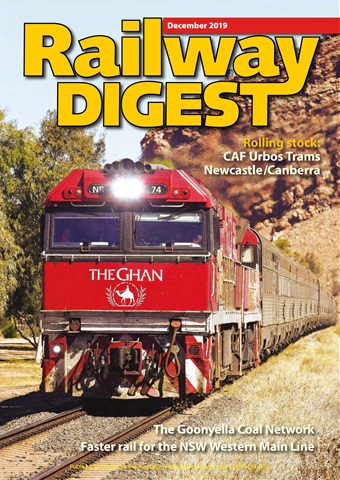
The first railway to serve coal deposits west of Mackay in Queensland’s huge Bowen Basin, covering an area of over 60,000 square kilometres and containing the largest coal reserves in Australia, was officially opened by Governor-General Sir Paul Hasluck on 5 November 1971. The railway linked a new export shipping terminal at Hay Point to Goonyella coal mine – joining two locations almost unknown at that time. However, within a few decades the word “Goonyella“ would become synonymous with one of the world’s largest and most heavily-trafficked coal carrying rail networks. John Hoyle takes a detailed look at a system that, today, comprises a total of 1,021.3 track kilometres with 182.773 kilometres of double track, hosting trains that typically consist of 126 hopper wagons hauled by three 4000 kW locomotives.

Faster rail for the NSW Western Main Line
The three main lines out of Sydney, Northern, Southern and Western, and the South Coast line, all have alignment problems. These are exemplified by an excess of curvature, created in the early 1900’s in order to get easier grades for the then small-wheeled steam locomotives. Of these routes, the Western line has always been a bit of an orphan. Crossing the Blue Mountains, where severe gradients and curvature were unavoidable, there followed around 250 km of rolling country that was not conducive to good alignment. As a result, Western passenger trains have always been slower than those on other mainlines. Philip Laird and Max Michell examine some upgrading options for that part of the NSW Main Western line between Lithgow to Orange.
read more read less
Railway Digest Preview Pages Railway Digest Preview Pages Railway Digest Preview Pages Railway Digest Preview Pages Railway Digest Preview Pages Railway Digest Preview Pages

Railway Digest

December 2019 The Goonyella Coal Network The first railway to serve coal deposits west of Mackay in Queensland’s huge Bowen Basin, covering an area of over 60,000 square kilometres and containing the largest coal reserves in Australia, was officially opened by Governor-General Sir Paul Hasluck on 5 November 1971. The railway linked a new export shipping terminal at Hay Point to Goonyella coal mine – joining two locations almost unknown at that time. However, within a few decades the word “Goonyella“ would become synonymous with one of the world’s largest and most heavily-trafficked coal carrying rail networks. John Hoyle takes a detailed look at a system that, today, comprises a total of 1,021.3 track kilometres with 182.773 kilometres of double track, hosting trains that typically consist of 126 hopper wagons hauled by three 4000 kW locomotives. Faster rail for the NSW Western Main Line The three main lines out of Sydney, Northern, Southern and Western, and the South Coast line, all have alignment problems. These are exemplified by an excess of curvature, created in the early 1900’s in order to get easier grades for the then small-wheeled steam locomotives. Of these routes, the Western line has always been a bit of an orphan. Crossing the Blue Mountains, where severe gradients and curvature were unavoidable, there followed around 250 km of rolling country that was not conducive to good alignment. As a result, Western passenger trains have always been slower than those on other mainlines. Philip Laird and Max Michell examine some upgrading options for that part of the NSW Main Western line between Lithgow to Orange.


SELECCIONAR FORMATO:
Acceso instantáneo

Ofertas digitales disponibles:

Ejemplar digital único December 2019
OFERTA ESPECIAL: Era €7,99
 
1,19 / edición
Este número y otros números atrasados no se incluyen en un Railway Digest suscripción. Las suscripciones incluyen el último número de la revista y los nuevos números publicados durante el periodo de suscripción. €7,92 por número . Si desea suscribirse, consulte nuestro Opciones de suscripción
Los ahorros se calculan sobre la compra comparable de números sueltos durante un periodo de suscripción anualizado y pueden variar respecto a los importes anunciados. Los cálculos son meramente ilustrativos. Las suscripciones digitales incluyen el último número y todos los números regulares publicados durante su suscripción, a menos que se indique lo contrario. El periodo elegido se renovará automáticamente a menos que se cancele en el área Mi cuenta hasta 24 horas antes del final de la suscripción actual.

Railway Digest issue December 2019

Railway Digest  |  December 2019  


The Goonyella Coal Network
The first railway to serve coal deposits west of Mackay in Queensland’s huge Bowen Basin, covering an area of over 60,000 square kilometres and containing the largest coal reserves in Australia, was officially opened by Governor-General Sir Paul Hasluck on 5 November 1971. The railway linked a new export shipping terminal at Hay Point to Goonyella coal mine – joining two locations almost unknown at that time. However, within a few decades the word “Goonyella“ would become synonymous with one of the world’s largest and most heavily-trafficked coal carrying rail networks. John Hoyle takes a detailed look at a system that, today, comprises a total of 1,021.3 track kilometres with 182.773 kilometres of double track, hosting trains that typically consist of 126 hopper wagons hauled by three 4000 kW locomotives.

Faster rail for the NSW Western Main Line
The three main lines out of Sydney, Northern, Southern and Western, and the South Coast line, all have alignment problems. These are exemplified by an excess of curvature, created in the early 1900’s in order to get easier grades for the then small-wheeled steam locomotives. Of these routes, the Western line has always been a bit of an orphan. Crossing the Blue Mountains, where severe gradients and curvature were unavoidable, there followed around 250 km of rolling country that was not conducive to good alignment. As a result, Western passenger trains have always been slower than those on other mainlines. Philip Laird and Max Michell examine some upgrading options for that part of the NSW Main Western line between Lithgow to Orange.
Seguir leyendo leer menos
Railway Digest brings you the very latest in railway news. Published every month since 1963, each exciting issue of Railway Digest contains:

• News
• Full length articles on current topics
• Historical and operations information from all of Australia’s railways
• Photographs from Australia’s leading rail photographers

If you are a railway enthusiast then this is the magazine for you. Download your copy now.

omo abonado recibirá las siguientes ventajas:


•  Un descuento sobre el PVP de su revista
•  Las nuevas ediciones se envían a tu dispositivo el día de su lanzamiento
•  Nunca te perderás un número
•  Estás protegido de las subidas de precios que puedan producirse más adelante en el año

Recibirás 12 problemas durante un año Railway Digest suscripción a la revista.

Nota: Las ediciones digitales no incluyen los artículos de portada ni los suplementos que encontraría en los ejemplares impresos.

Su compra aquí en Pocketmags.com puede leerse en cualquiera de las siguientes plataformas.


Puedes leer aquí en el sitio web o descargar la aplicación para tu plataforma, sólo recuerda iniciar sesión con tu nombre de usuario y contraseña de Pocketmags.

Apple Pocketmags Online Pocketmags Google Pocketmags
La aplicación Pocketmags funciona en todos los dispositivos iPad y iPhone con iOS 15.6 o superior, Android 8.0 o superior y tabletas Amazon Fire de 2018 en adelante, aunque los propietarios de modelos Fire anteriores pueden consultar la Amazon Appstore directamente en su dispositivo para confirmar la compatibilidad. Para los usuarios de iOS, recomendamos utilizar un dispositivo capaz de ejecutar la última versión de iOS para un rendimiento y estabilidad óptimos, ya que el hardware más antiguo con menor potencia de procesamiento y memoria RAM puede experimentar una renderización de páginas más lenta o problemas ocasionales de estabilidad debido a las limitaciones de memoria del dispositivo. Alternativamente, nuestro lector web funciona con cualquier navegador moderno compatible con HTML5, aunque recomendamos Chrome o Firefox para disfrutar de la mejor experiencia en PC y Mac.
4,7
/5
Basado en 22 Opiniones de los clientes
5
16
4
5
3
1
2
0
1
0
Ver comentarios

Artículos de este número


A continuación encontrará una selección de artículos en Railway Digest December 2019.

Free Sample Issue
Pruebe una muestra GRATIS de Railway Digest
Chat
X
Soporte Pocketmags